Flying In for the Sepang GP: Flights, Visas, Money and the Hotel Warning
Planning the 2026 Sepang F1 trip from the UK, US, Australia or Europe: which airlines fly direct, the visa and arrival-card rules, what things actually cost, and why you need to book a hotel this week.
Last updated:
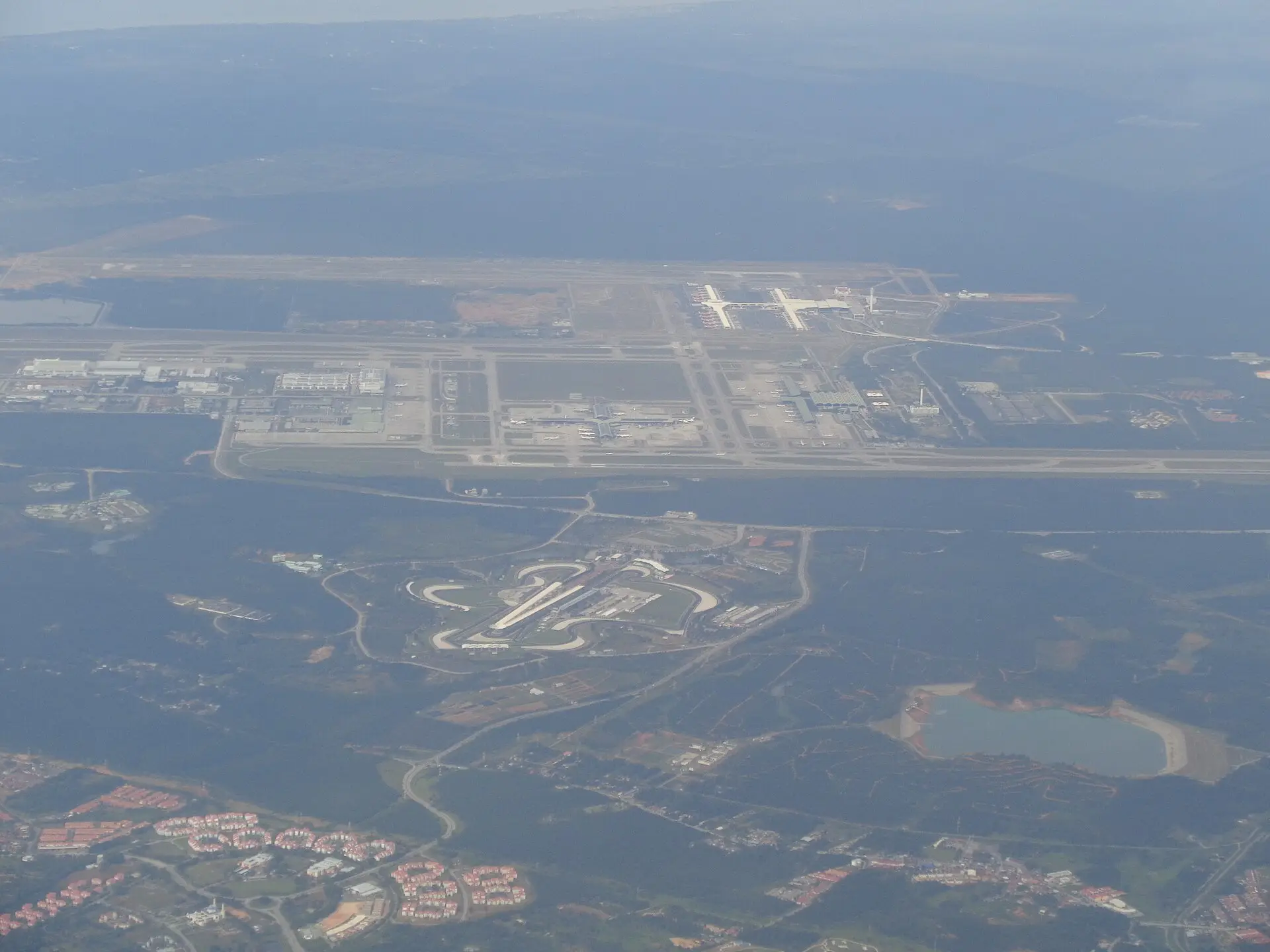
Formula 1 announced Sepang as the 2026 host with roughly nine weeks’ notice. That’s an unusually short runway for a long-haul trip, and it means the normal advice — book early, shop around — has already partly expired.
This is the practical planning guide for anyone flying in from the UK, the US, Australia or Europe: what you can actually fly, what paperwork you need, what things cost, and the one thing you should stop reading and go do right now.
Start here: the hotel situation is already bad
Two things make this worse than a normal race weekend. First, the announcement was late, so a full year of demand is compressing into a few weeks of booking. Second, two other major events land on the same weekend: Le Tour de Langkawi finishes on 4 October, and the Kuala Lumpur Standard Chartered Marathon runs on 3–4 October.
The useful finding in that survey is that central Kuala Lumpur barely moved. One central KL hotel rose about 18% against a near-tripling out at the airport end. So:
Stay in central KL and commute out on race days. You get city prices, the food, the rail links, and a base that also works for the overland run to Singapore afterwards. The circuit is about 30 minutes from the city by road when traffic behaves.
If you want to be closest to the circuit anyway, the KLIA / Putrajaya / Cyberjaya cluster is where you’d stay — it’s the zone where the price spike is worst, so decide whether the shuttle-length convenience is worth the multiple.
Singapore is the bigger problem. Marina Bay, City Hall, Orchard and the CBD hit their highest rates of the year during Grand Prix week, and the usual advice is to book three to six months ahead. As of now you are late. Book the Singapore end first — it’s the expensive, scarce half of the trip, and 2026 is Singapore’s first Sprint weekend, which will only add demand.
Getting to Kuala Lumpur
Direct flights, by region
| From | Non-stop options | Flight time |
|---|---|---|
| London Heathrow | Malaysia Airlines, British Airways | ~13h 20m |
| Amsterdam | KLM, 4× weekly | ~12h 25m |
| Paris CDG | Malaysia Airlines, daily | ~13h 25m |
| Istanbul | Turkish Airlines | ~10h 50m |
| Doha | Qatar Airways, Malaysia Airlines | ~7h 25m |
| Sydney | Malaysia Airlines, AirAsia X | ~8h 25m |
| Melbourne | Malaysia Airlines, AirAsia X | ~7h 55m |
| Perth | AirAsia X, Batik Air, Malaysia Airlines | ~5h 35m |
| United States | None — no non-stop service exists | 24–30h with one stop |
From the US, every routing is at least one stop — commonly Doha, Dubai, Istanbul, Tokyo, Seoul or Hong Kong — and door to door usually runs 24 to 30 hours. Build in a recovery day; Sepang in October is not a place to arrive jetlagged and dehydrated.
From Australia, this is close to a domestic hop by long-haul standards. Perth to KL is five and a half hours. October has historically been among the cheaper months on the Sydney route.
The open-jaw trick
If you’re doing both races, don’t book a return to Kuala Lumpur. Book into KUL and home out of Singapore as a multi-city ticket.
Airline fare rules generally price each leg of an open-jaw at about half a round-trip fare, so it typically lands close to a normal return and well below two one-way tickets. Both cities are major long-haul hubs with their own home carriers, so the flight home from Singapore isn’t a thin route you’d pay a premium to escape.
That leaves the middle section — Kuala Lumpur to Singapore — to do on the ground, which is the best part of the trip anyway. If you’d rather skip it, the flight is about 65 minutes.
Visas and arrival cards
Neither country needs an advance visa for a two-week trip on a UK, US, Australian or German passport. Both need a free digital arrival card, and each country needs its own — filing one does not cover you for the other.
Malaysia
- Visa-free stay: normally 90 days on arrival for UK, US, Australian, German and other EU passports
- Passport validity: at least 6 months beyond arrival, undamaged, no missing pages
- MDAC (Malaysia Digital Arrival Card): mandatory, free, submitted online within the 3 days before you arrive — you can’t file earlier. Airlines may ask to see it at check-in. The only official portal is
imigresen-online.imi.gov.my/mdac/main - Onward travel: carry proof of your onward booking out of Malaysia — the US State Department lists it as a requirement
- Cash or monetary instruments over the equivalent of US$10,000 must be declared
Singapore
- Visa-free stay: normally 90 days for US, Australian and German passports. British passport holders are a special case — the UK government’s own wording is “normally between 30 and 90 days”, and the period granted is at the officer’s discretion at the checkpoint. Don’t plan on 90 as a guarantee
- Passport validity: at least 6 months beyond arrival
- SG Arrival Card: mandatory, free, submitted within 3 days including your arrival day, via the ICA website or the MyICA Mobile app. It includes a health declaration
- Biometrics (fingerprints, iris, face) are captured on both entry and exit
- Vaporisers and e-cigarettes are prohibited items — this catches visitors out constantly, and the penalties are real. Leave them at home rather than in your bag
What things cost
Malaysia is one of the best-value destinations in Asia, and the gap between it and Singapore is enormous. Typical Kuala Lumpur prices:
| Kuala Lumpur | |
|---|---|
| Hawker or inexpensive restaurant meal | RM 20 |
| Mid-range dinner for two, three courses | RM 100 |
| Draught beer, 0.5 L, in a bar | RM 18 |
| Imported beer, 0.33 L bottle | RM 25 |
| Bottled water, 0.33 L | RM 1.86 |
| Single metro or bus ride | RM 3 (about 10% less with a Touch ‘n Go card) |
| Grab across the city centre | RM 10–20 |
| Three-star hotel, normal season | ~RM 150/night |
| Four-star hotel, normal season | ~RM 290/night |
Then you cross into Singapore
| Singapore vs Kuala Lumpur | |
|---|---|
| Restaurant prices | about 2× |
| Groceries | +83% |
| Overall cost of living, excluding rent | about 2.4× |
| Accommodation | about 5× |
| Cheap meal | RM 20 → about RM 48 |
| Bottled water | RM 1.86 → about RM 4.83 |
| Taxi per kilometre | about 37% cheaper — the one thing that isn’t worse |
Budget roughly double for food and drink, and two and a half to three times overall from the moment you cross the causeway.
Practical things nobody tells you
Tipping is not customary. Most restaurants and hotels already add a 10% service charge. Rounding up a taxi fare is welcome; a 15–20% tip is not expected anywhere. American visitors especially: you can stop doing the mental arithmetic.
Don’t drink the tap water. The supply leaves treatment plants clean, but Malaysia’s ageing pipe network means contamination can occur between plant and tap. Bottled, boiled or filtered only — and bottled water costs under RM 2.
Plugs are Type G at 240 V — the UK three-pin standard. British and Irish travellers need no adapter. Everyone else does, and Americans should check their devices accept 240 V (phone and laptop chargers almost always do; hair dryers and shavers often don’t).
Traffic drives on the left, in right-hand-drive cars. Comfortable for UK and Australian visitors, a day’s adjustment for everyone else. If you’re renting, carry an International Driving Permit alongside your home licence — many rental firms want one.
Time zone: UTC+8, no daylight saving — and Singapore is identical. There is zero time change between Kuala Lumpur and Singapore, which makes the two-race trip unusually painless. From home, that’s 7 hours ahead of UK summer time, 6 ahead of central Europe, 12 ahead of US Eastern, and 3 behind Sydney.
Daylight is a flat 12 hours. On the equator there’s no long summer evening: sunrise around 07:00, sunset around 19:05 in early October, all year round. Darkness arrives fast. Plan sightseeing and photography earlier in the day than European instinct suggests.
Temple dress code. At Batu Caves and other temples, shoulders and knees must be covered — men and women alike. Tank tops, short shorts and beachwear will be refused at the steps, where you can buy or hire a sarong for roughly RM 6–15, cash only. Entry to the main Temple Cave is free. Shoes off where indicated, and don’t let the macaques near your bag.
Your booking order, in priority
- Singapore accommodation — scarcest and most expensive; do this first
- Flights, ideally open-jaw into Kuala Lumpur and out of Singapore
- Kuala Lumpur accommodation — central, not airport-side
- Sepang race tickets — on sale as of September 7, 2026, though the Main Grandstand and C Hillstand have sold out (details, including the phone line that is still selling)
- Singapore GP tickets — already on sale
- Overland transport between the two — book two to four weeks out, sooner for the train
- MDAC and SG Arrival Card — 3 days before each border, free, on your phone
Prices, schedules and entry rules checked 30 July 2026. Airfares and hotel rates move constantly and the figures here are indicative — verify with the airline, hotel or official government portal before you rely on them. Visa and arrival-card requirements can change with little notice; the official immigration sites are the only authority.
Frequently asked questions
Do I need a visa to visit Malaysia for the 2026 F1 race?
Passport holders from the UK, USA, Australia, Germany and the rest of the EU do not need a visa and are normally granted 90 days on arrival. You do need to file the free Malaysia Digital Arrival Card (MDAC) online within the three days before you land, and your passport must be valid for at least six months.
What is the MDAC and does it cost anything?
The Malaysia Digital Arrival Card is a mandatory free online form for almost all foreign visitors, submitted within 72 hours of arrival at imigresen-online.imi.gov.my. It costs nothing. Third-party sites charging a fee for it are scams — some have charged as much as US$80.
Are there direct flights to Kuala Lumpur from the United States?
No. There are no non-stop flights from anywhere in the USA to Kuala Lumpur. Every routing involves at least one stop, typically via Doha, Dubai, Istanbul, Tokyo, Seoul or Hong Kong, with total journey times commonly running 24 to 30 hours.
How expensive is Malaysia compared with Singapore?
Malaysia is dramatically cheaper. Expect to pay roughly double for restaurant meals and around two and a half to three times more overall once you cross into Singapore, with accommodation the most extreme difference. A hawker meal costs about RM 20 in Kuala Lumpur.
Do I need a power adapter for Malaysia?
Malaysia uses the Type G three-pin plug at 240 V, the same as the United Kingdom, so British and Irish travellers need no adapter. American, European and Australian visitors do need one, and Americans should check their devices accept 240 V.