21 Things You Didn't Know About Sepang — F1's Most Underrated Circuit
The widest circuit on the F1 calendar, carved out of a palm oil plantation, and the venue that gave us Multi 21 and a race stopped by darkness. The story and strange trivia of Sepang International Circuit, back on the F1 calendar in 2026.
Last updated:
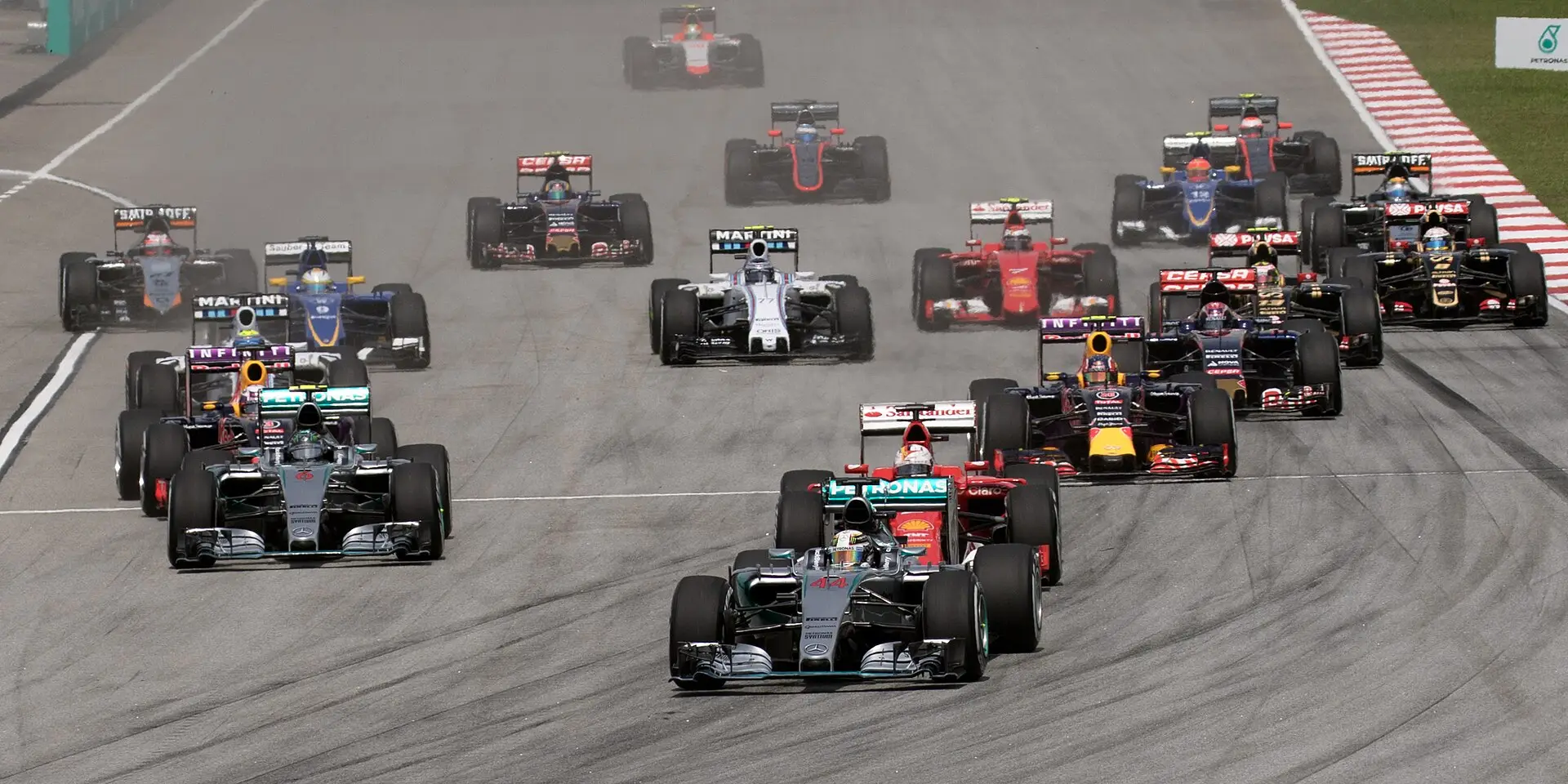
Nine years is a long time to be off the calendar. When Formula 1 returns to Sepang International Circuit on 2–4 October 2026, a whole generation of fans will be seeing it live for the first time — and a whole generation of drivers will be learning a circuit their predecessors talk about like a lost favourite.
Sepang deserves the reverence. It is fast, punishing, architecturally strange, and it has produced some of the weirdest races in modern F1 history. Here’s what makes it worth the flight.
It was the first F1 circuit Hermann Tilke drew from scratch
Every modern purpose-built Grand Prix track — Shanghai, Bahrain, Istanbul, Austin, Abu Dhabi — traces back to a German engineer named Hermann Tilke. Sepang, opened in 1999, was the first F1 circuit he designed from a blank sheet.
It wasn’t quite his first F1 venue: he had already reshaped Austria’s Österreichring into the A1-Ring, which returned to the calendar in 1997. But that was a renovation. Sepang is where he got to start with an empty field and decide what a modern Grand Prix circuit should be — enormous run-off, two long straights ending in heavy braking zones, and a spread of corner speeds designed so no single car setup is ever perfect. Every “Tilkedrome” since is a variation on what he tried here.
It was carved out of a palm oil plantation
The site was an oil palm plantation, part of the same 1990s building spree that gave Malaysia the Petronas Towers and a new administrative capital at Putrajaya. Ground was broken in December 1996 and the circuit was completed in November 1998, with Prime Minister Mahathir Mohamad inaugurating it on 7 March 1999.
The layout is a deliberate optical trick
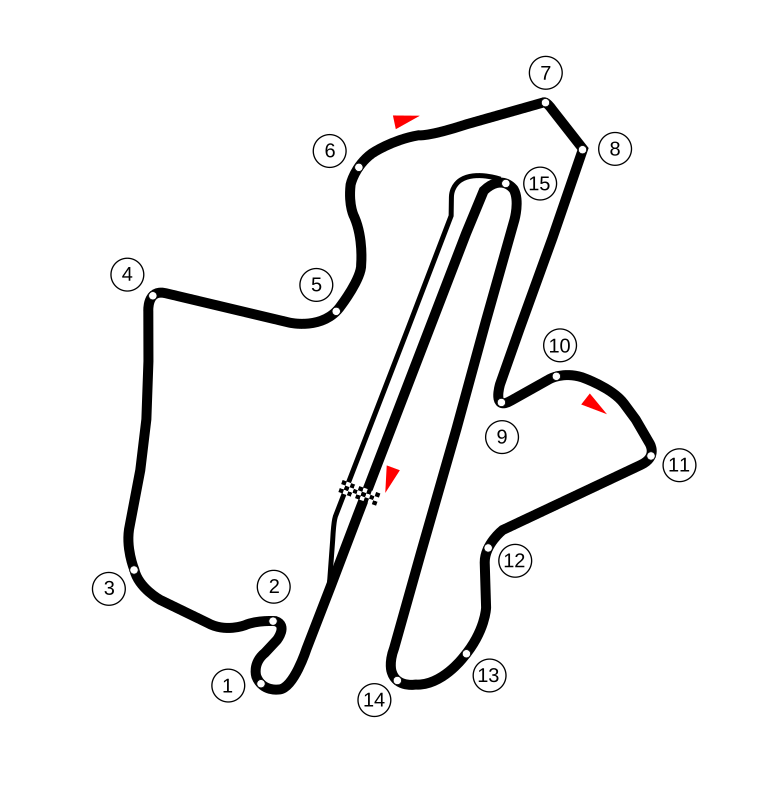
Look at the map and you’ll spot the signature move: the 927-metre back straight runs alongside the pit straight in the opposite direction, joined at one end by a single very tight hairpin (Turn 15).
That geometry is why Sepang produces overtaking. Two long straights back to back means a driver who loses a place into Turn 15 gets an immediate second chance down the pit straight into Turn 1 — and if that fails, another one at the end of the back straight. Sepang rarely lets a fight die.
It was the widest circuit on the F1 calendar
The track measures 16 to 22 metres wide, averaging around 16 — wider than anywhere else F1 raced. For reference, a Formula 1 car is under two metres across.
That width is why photographs of Turn 1 at Sepang look the way they do: cars fanned right across the asphalt, taking wildly different lines into the same corner. Turn 1 is a wide, multi-apex right-hander that rewards bravery and punishes optimism, and it has hosted most of Sepang’s memorable first-lap chaos.
Nobody quite agrees what the grandstand roof is meant to be
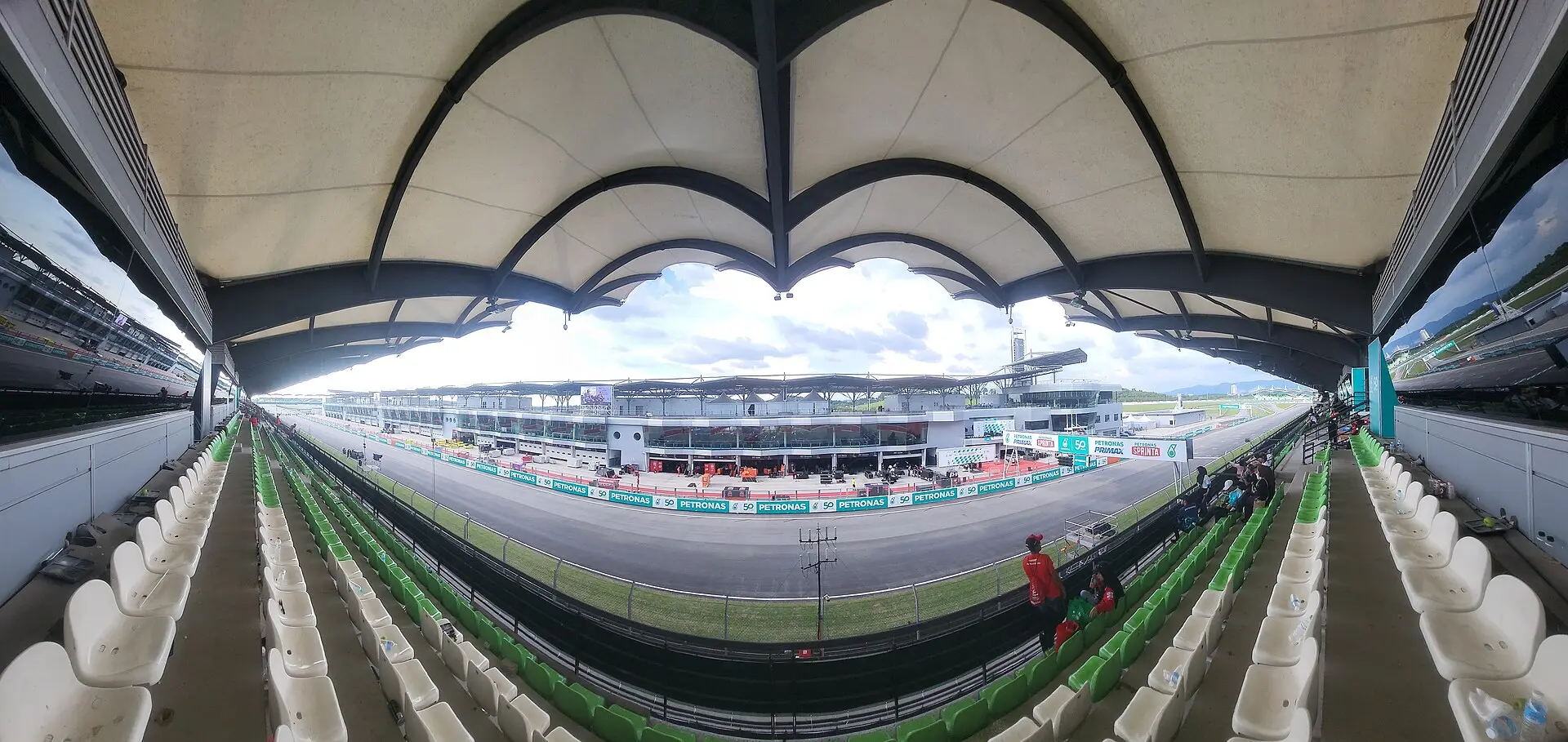
That swooping canopy over the main straight is the circuit’s signature image, and there are three competing stories about it. The most repeated is that it echoes the hibiscus, Malaysia’s national flower. Several circuit histories instead describe the canopies as oil-palm fronds, a nod to the plantation the track replaced. The contractor who actually built the tensile structure — 44,000 square metres of PVDF membrane — calls it, unromantically, an inverted cone.
What isn’t in dispute is the practical bit: the stand runs east to west so that it stays in shade. Three degrees north of the equator, that’s not decoration. It’s the single best argument for paying up for a covered seat.
You can watch planes land from the grandstand
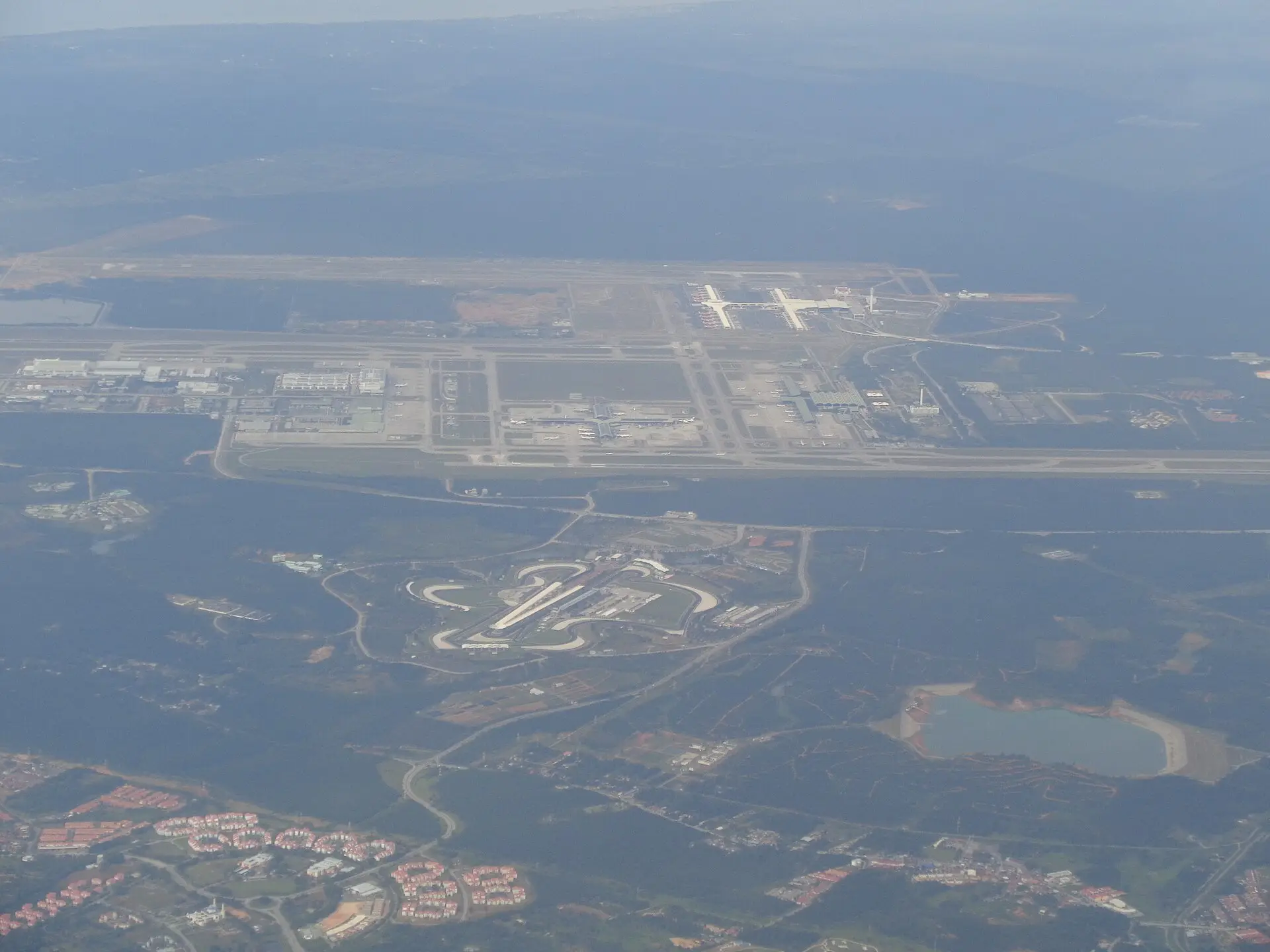
Sepang sits right next to Kuala Lumpur International Airport — about ten minutes by road. Widebodies on final approach pass over the circuit all weekend, which makes for one of motorsport’s better photographic backdrops and one of its more convenient arrivals: you can land at KLIA and be at the gates before your luggage would have reached the carousel at Silverstone.
The weather is a co-driver
October in Sepang is inter-monsoon season: around 32°C, humidity in the eighties, and a genuine chance of a thunderstorm every afternoon. Sepang doesn’t do drizzle. It does a wall of water that turns the track into a river in under a minute, then clears to blue sky twenty minutes later. This has decided races. Repeatedly.
2009: the race that was stopped by darkness — and settled by rewinding two laps
A monsoon arrived, and the race was red-flagged on lap 33 with the light already going behind the storm. It never restarted.
Here’s the part most people miss: because the race was stopped, the result was counted back to the end of lap 31 — the last lap every car had completed. Jenson Button was classified the winner on that countback. And because less than 75% of the distance had been run, only half points were awarded — only the fifth time in Formula 1 history that had happened, and the first since the 1991 Australian Grand Prix.
1999: Ferrari won, was disqualified, then won again — and it was Irvine’s last
The very first Grand Prix at Sepang set the tone. Eddie Irvine won for Ferrari, then both Ferraris were disqualified for a technical irregularity in scrutineering. The team appealed, the exclusion was overturned, and Irvine got his win back.
It turned out to matter more than anyone realised at the time: that reinstated Sepang victory was the last Grand Prix win of Eddie Irvine’s career.
2001: the win Ferrari threw away and then took back
The story usually told is that Michael Schumacher and Rubens Barrichello spun in the rain and recovered to a one-two. The real version is better.
On lap 3, fresh rain lifted oil that Olivier Panis’s BAR had laid on the track. Both Ferraris slid straight off into the gravel, rejoining third and seventh — recoverable. What actually wrecked their race was the pit stop: under the safety car, a miscommunication left Schumacher queueing behind his own team-mate for over a minute. They came out tenth and eleventh.
Ferrari then gambled on intermediate tyres while the track was still soaked, the call came good, and both cars carved back through the field to finish one-two. It remains one of the great strategic saves of the modern era.
Multi 21 happened here
On 24 March 2013, Sebastian Vettel was told to hold position behind team-mate Mark Webber. He passed him anyway with thirteen laps to go and won.
The fallout — “Multi 21” — defined Red Bull’s season and arguably ended Webber’s Formula 1 career; he left at the end of the year. It happened at Sepang.
2016: the engine that ended a title fight
Lewis Hamilton was leading by roughly twenty seconds when his Mercedes engine let go on lap 41, in a plume of smoke and one of the most quoted radio messages of the decade. Daniel Ricciardo inherited the win ahead of Max Verstappen for a Red Bull one-two, while Nico Rosberg recovered to third after being spun at Turn 1 by Sebastian Vettel, who retired on the spot with broken suspension.
2017: a farewell weekend that had everything
The last Malaysian Grand Prix, on 1 October 2017, went to Max Verstappen. He had turned 20 the day before, on qualifying Saturday, then dived past pole-sitter Lewis Hamilton into Turn 1 on lap four and drove away to win by twelve seconds. It was only the second victory of his career.
Ferrari’s weekend was a catalogue of disasters that somehow produced the circuit’s fastest ever lap. Kimi Räikkönen qualified second and never took the start — his power unit failed on the way to the grid. Vettel’s engine had failed in practice, so he started from the back, carved through to fourth, and on lap 41 set a 1:34.080 that still stands as the F1 race lap record at Sepang.
Then, on the cool-down lap, Vettel collided with Lance Stroll, lost a wheel, and got back to the paddock riding on the sidepod of Pascal Wehrlein’s Sauber. Formula 1’s last act at Sepang was a four-time world champion hitchhiking home.
The record book
- Most F1 wins at Sepang (driver): Sebastian Vettel, with four (2010, 2011, 2013, 2015)
- Most F1 wins at Sepang (constructor): Ferrari, with seven
- Most laps led: Fernando Alonso, with 169 — about three full race distances, more than anyone else
- F1 race lap record: 1:34.080 — Sebastian Vettel, Ferrari SF70H, 2017
- Circuit capacity: around 130,000
- F1 era: 1999–2017, then 2026
Alonso’s Sepang record is the quiet oddity in that list. He never topped the win count, but he led more laps there than anyone, took his first F1 pole and first podium at the circuit in 2003, and won there with three different teams — Renault in 2005, McLaren in 2007 and Ferrari in 2012.
Malaysia has produced exactly one F1 driver
Alex Yoong remains the only Malaysian to race in Formula 1: 18 entries, 14 starts, no points, and a best finish of seventh at the 2002 Australian Grand Prix. At his only home Grand Prix, in 2002, he qualified 22nd, suffered a refuelling rig failure at his first stop, and retired after contact with Eddie Irvine.
It’s a fitness test disguised as a race
Heat plus humidity plus a physically demanding layout makes Sepang one of the hardest races on the calendar. Cockpit temperatures climb, drivers lose significant body weight in fluid over a race distance, and hydration becomes a genuine performance variable rather than a footnote.
Spectators get a milder version of the same problem. Plan accordingly — a poncho, a hat, and more water than you think you need.
The bikes never left — and they out-drew F1
Losing the Grand Prix in 2017 didn’t shutter Sepang. MotoGP stayed, along with endurance racing and the winter MotoGP tests that make Sepang a familiar name to bike fans who have never watched an F1 race.
And MotoGP wasn’t just surviving here — it was winning. In 2017 the Malaysian motorcycle Grand Prix drew a record 166,486 spectators across the weekend, with 97,457 on race day alone. The Formula 1 weekend three weeks earlier had drawn 110,604 in total. One event was growing; the other wasn’t.
The circuit also carries a solemn place in motorcycle racing history: Marco Simoncelli died following a crash at the 2011 Malaysian motorcycle Grand Prix, and he is remembered at the circuit and across the paddock.
The 2016 resurfacing quietly changed the track
Ahead of what turned out to be its penultimate F1 race, Sepang was completely resurfaced — and the work went further than new asphalt. Nine corners were modified, more than 600 metres of kerbing was rebuilt, and the inside of the final corner was raised by about a metre to force drivers into a later apex.
Worth remembering when you compare 2026 lap times against a record set on that 2016 surface.
Why Malaysia left
The exit was economics, not enthusiasm. Hosting fees rose, F1 ticket sales fell, and by 2017 the sums no longer worked against a calendar of newer venues willing to pay more.
And why the comeback is stranger than it looks
The return, in 2026, is one of the odder stories in recent F1 history. The Bahrain Grand Prix could not be held in Bahrain, and rather than lose the race entirely, Formula 1, the FIA and both governments agreed to move it to Sepang. So the race in October 2026 is, officially, the Formula 1 Gulf Air Bahrain Grand Prix — a Bahraini Grand Prix, run in Malaysia, sitting between Azerbaijan and Singapore on the calendar.
The financial arrangement is unusual too. Bahrain pays the hosting fee, sets the ticket prices and keeps the ticket revenue; Sepang shares operating costs reported at around US$13 million and is banking on the spillover — hotels, flights, restaurants, the country back on the F1 map — rather than gate receipts. The circuit’s chief executive has said publicly that a permanent return would need on the order of RM 300 million a year, with hosting rights alone running to US$70–80 million.
Which is the honest answer to “will Malaysia keep its Grand Prix?” — this one is a one-off unless somebody finds that money. Enjoy it accordingly.
Facts checked 30 July 2026 against Formula 1, Sepang International Circuit, FIA and contemporary race reports. Where sources conflict — the construction timeline and the grandstand roof’s inspiration — we’ve said so rather than picking the tidier version. The 2026 race remained subject to final World Motor Sport Council ratification at the time of writing.
Frequently asked questions
Who designed the Sepang International Circuit?
German circuit architect Hermann Tilke. Sepang was the first Formula 1 circuit he designed from scratch — he had already reworked the Österreichring into the A1-Ring, which hosted F1 from 1997 — and it set the template for the modern Tilke track: wide, technical, and built around big braking zones.
How long is the Sepang circuit and how many corners does it have?
The main Grand Prix layout is 5.543 km (3.444 miles) with 15 corners. The back straight alone is 927 metres, separated from the pit straight by a single very tight hairpin.
Why does the Sepang grandstand have that unusual roof?
It is usually described as being inspired by the hibiscus, Malaysia's national flower, though some accounts read the canopies as oil-palm fronds instead, and the roof contractor simply calls the structure an inverted cone. Whatever the inspiration, the stand is aligned east to west so that it stays shaded.
What is the Formula 1 lap record at Sepang?
Sebastian Vettel set the F1 race lap record of 1:34.080 in a Ferrari SF70H during the 2017 Malaysian Grand Prix — the very last F1 race held at the circuit before its 2026 return, in a weekend where he had started from the back of the grid.
Why did Malaysia lose its Formula 1 race after 2017?
Rising hosting fees combined with declining ticket sales made the race economically unsustainable — in 2017 the MotoGP weekend at the same circuit outdrew the Grand Prix by more than fifty thousand spectators. Malaysia stepped away after that season, and F1 did not return until 2026, when Sepang was chosen to host the relocated Bahrain Grand Prix.