A Lap of Sepang: All 15 Turns Explained — and Where to Sit for the Overtakes
A corner-by-corner guide to Sepang International Circuit, which grandstand overlooks which turns, and where passes actually happen. Written to help you pick a seat for the 2026 race.
Last updated:
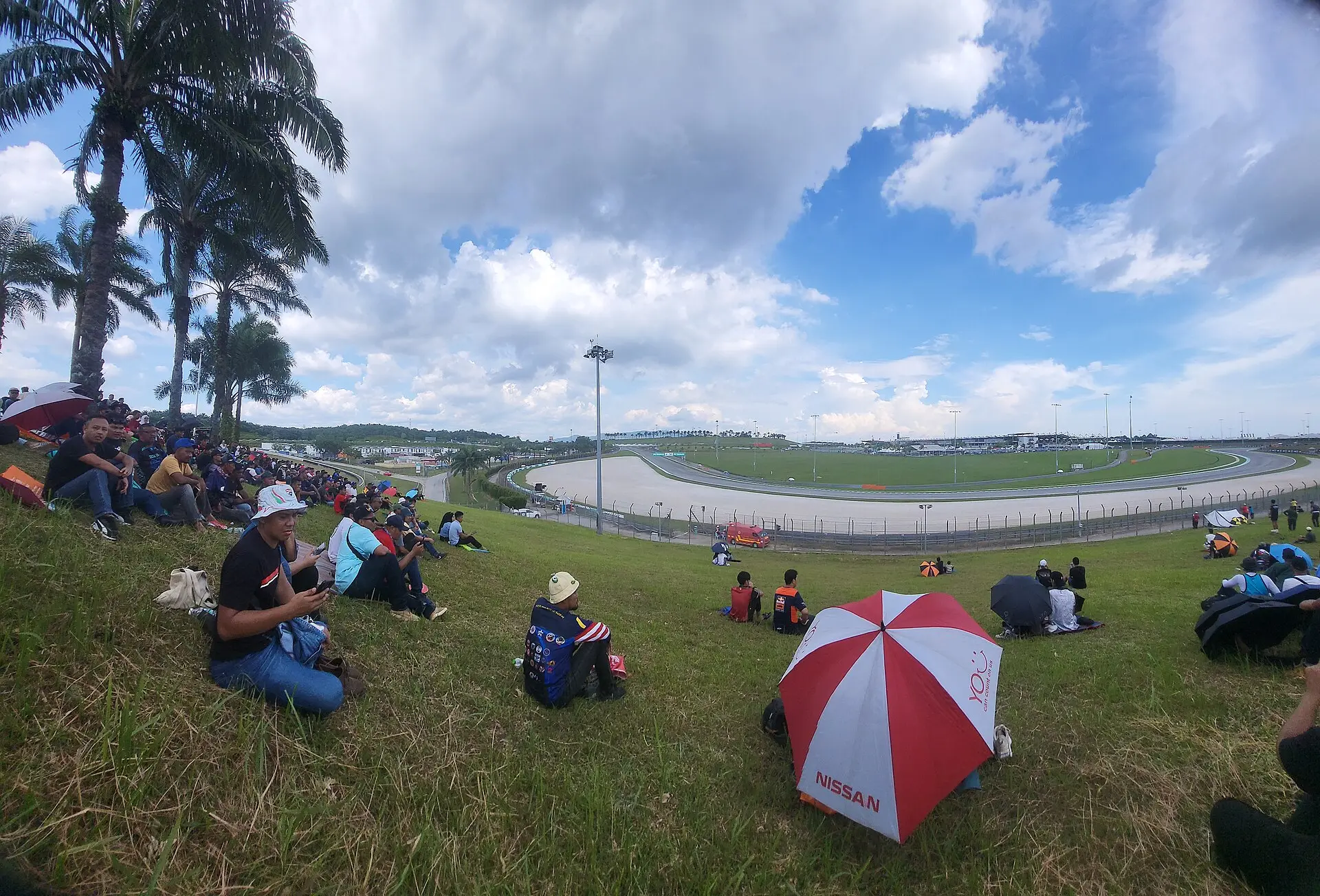
Choosing a seat at a circuit you’ve never visited is mostly guesswork, and the marketing copy on ticket pages is not much help. This guide is the version we’d give a friend: what each of Sepang’s fifteen corners actually does, where cars genuinely pass each other, and which stand looks at which piece of track.
The shape of the lap
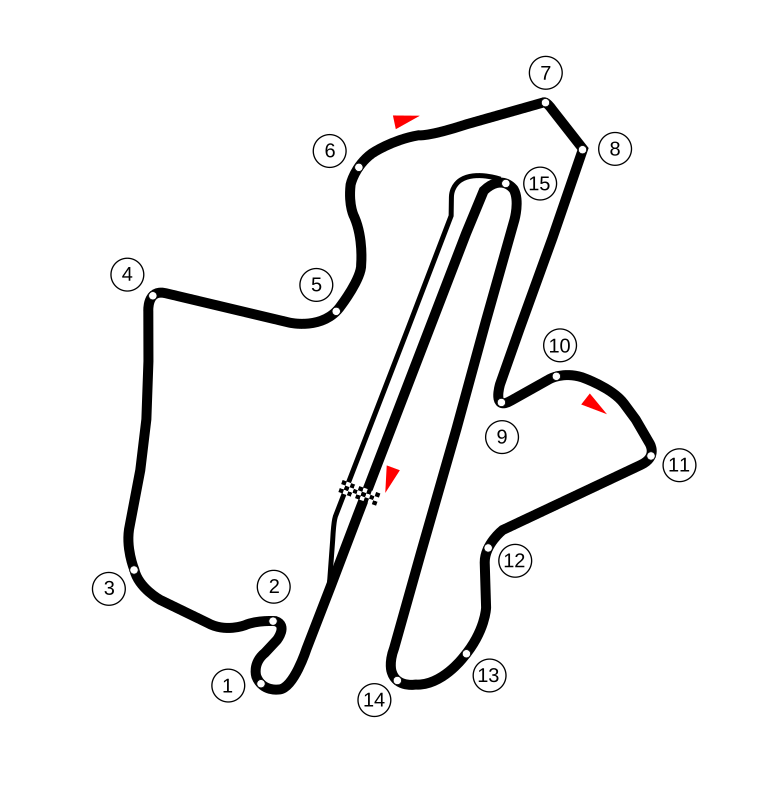
Start with the geometry, because it explains everything else. The 927-metre back straight runs back alongside the pit straight in the opposite direction, and the only thing joining them is the tight Turn 15 hairpin. Two enormous straights, back to back, each ending in a heavy braking zone.
That’s why Sepang produces racing. Lose a place into Turn 15 and you get an immediate second attempt into Turn 1. Lose it there and the back straight gives you a third. A fight here rarely dies in one corner.
The lap also climbs and falls more than photographs suggest — a maximum uphill gradient of about 3.7% and downhill of about 5.6%, with the high ground in the Turn 9 to 11 region. That matters for seat choice: elevation is why the hillstands see more than their position on the map implies.
Sector 1: the braking zones
Turn 1 — Pangkor Laut (right). The most important corner on the circuit. Cars arrive off the main straight at roughly 330 km/h and drop to around 90 km/h in second gear, then hold a long, wide, decreasing-radius arc for about six seconds. Because it tightens, drivers can’t just hit an apex and go — they bleed speed all the way round, and the front-left tyre pays for it. This is the single hardest braking zone on the lap and the reason Sepang eats tyres.
Turn 2 (left). A tight left that immediately reverses the direction, and the track drops away downhill near the apex — so the car goes light exactly where you want traction. Exit matters more than entry.
Turn 3 (right). Long and effectively flat out. Not a passing place, but a genuinely spectacular one to watch from — the cars are loaded up and accelerating hard.
Turn 4 — Langkawi Curve (right). A second-gear right-angle right at the end of the Turn 3 charge. Understeer-prone, with a pronounced apex kerb. A real, if secondary, overtaking spot.
Sector 2: where the circuit gets quick
Turns 5 and 6 — Genting Curve (left, then right). A very high-speed sequence on a long uphill rise, and one of the hardest bits of the lap. Turn 5 is off-camber with a late apex, taken above 230 km/h, with drivers holding around 3.4 G for nearly three seconds. Get it wrong and you’re a passenger.
Turns 7 and 8 — KLIA Curve (right). The long, medium-speed double-apex right. A bump partway through can unsettle the car, and the outer half of the exit kerb slopes away, so running wide is punished rather than forgiven.
Turn 9 — Berjaya Tioman (left). The slowest corner on the circuit, roughly 75 km/h, an uphill left hairpin with a crest right at the apex that makes most cars step sideways. It gets talked about as a passing corner, and it has the ingredients — but see the caveat below.
Turn 10 (right). A long uphill curved acceleration zone pulling up to 3 G. Rarely comfortably flat.
Turn 11 (right). Medium speed, and awkward because you’re still unwinding steering from Turn 10 as you brake.
Sector 3: the run to the hairpin
Turn 12 (left). Fast, bumpy, effectively flat, with the track dipping away and the rear going light. A corner that looks easy on television and isn’t.
Turn 13 (right). The fastest corner on the circuit at around 247 km/h. Braking for the next corner starts while you’re still in it.
Turn 14 — Sunway Lagoon (right). Medium speed and tightening, mixing braking with steering angle. It is not a passing corner — it’s the corner that decides whether you can pass at the end of the straight that follows. In 2012 Sergio Pérez’s charge at Fernando Alonso died right here when he took too much kerb.
Turn 15 (left). The tight final hairpin, and one of the widest points on the circuit. Since the 2016 rebuild the inside has been raised by a metre, making it deliberately off-camber — from +2% at the apex to −4%. The intent was to open up a second line and create passes.
The drivers were not charmed. Esteban Ocon called it off-camber to the point where you can’t take the apex; Carlos Sainz simply preferred the old one. Nico Rosberg was the dissenting optimist, arguing the best line no longer went near the apex at all — which is exactly the point if you’re sitting in a grandstand hoping to see someone try something.
Where passes actually happen
No one publishes per-corner overtaking statistics for Sepang, so treat this as an informed ranking rather than a table of data:
- Turn 1 — the primary spot, and it isn’t close. One of the longest runs to a first corner on the calendar, the heaviest braking zone, a DRS zone, and plenty of width to work with. Verstappen’s winning move in the last Malaysian Grand Prix was here, on lap four.
- Turn 15 — the second-heaviest braking, at the end of the 927-metre back straight, and since 2016 deliberately engineered to offer more than one line. The designer’s stated aim was to make the classic racing line no longer the fastest one.
- Turn 4 — better than its reputation. Reachable after the flat-out charge through Turn 3, and the corner where Sebastian Vettel went around the outside of Mark Webber to win the 2013 race and blow up his own team.
- Turn 9 — everybody lists it, including the circuit’s own designers after they added camber there in 2016. The ingredients are right: slow, uphill, heavy braking. But when we went looking for actual completed passes at Turn 9 in either Formula 1 or MotoGP, we mostly found attempts — moves that didn’t stick, and riders losing time. Treat it as optimistic.
- Turn 2 — mostly the completion of a move that started at Turn 1.
In its final Formula 1 configuration Sepang ran two DRS zones: one down the back straight into Turn 15, one along the pit straight into Turn 1. The FIA will publish a fresh determination for 2026, so don’t assume the old points carry over — but the two straights are where DRS will be, because that’s where the circuit is.
So where should you sit?
| Grandstand | Zone | Covered | From (MYR) | Views | Tips |
|---|---|---|---|---|---|
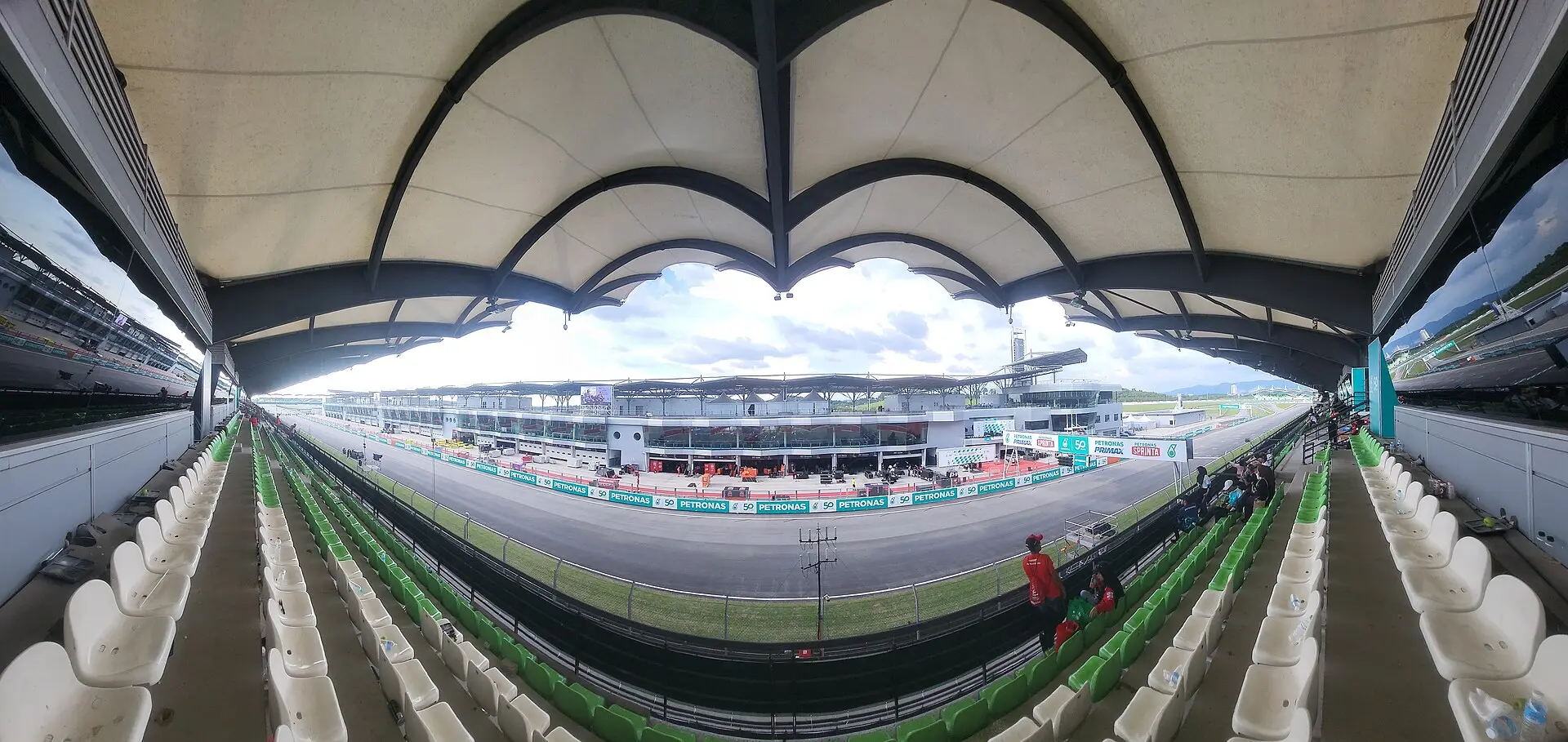
| Main Grandstand | Start/finish + back straight | Yes | TBA | Double-fronted: the grid, pit lane and podium on one side, the back straight on the other, plus Turn 1 and the final hairpin | About 30,000 seats and the only stand that sees both straights. Covered. The pick if it's your first F1 race. |
| K1 Grandstand | Turns 1–2 | Yes | TBA | The heaviest braking zone on the lap, where cars arrive at around 330 km/h and drop to about 90 km/h, plus the Turn 3 exit | Covered, and the single best seat for overtaking — most passes at Sepang happen right in front of it. |
| F Grandstand | Turns 6–8, plus Turn 15 | Yes | TBA | The KLIA Curve double-apex right, sightlines to both straights, and the final hairpin — ticketing sources claim over half the lap | Covered seat-backs. The best value if you want to watch racing rather than the podium ceremony. |
| C2 Hillstand | Turns 9–11 | No | TBA | The slow Turn 9 left hairpin — the slowest corner on the circuit at roughly 75 km/h — then the long uphill run through Turns 10 and 11 | Grass banking on the highest ground of the lap, so you see more than the map suggests. Partly sheltered; bring a poncho anyway. |
| K2 Hillstand | Northern section (exact corners unconfirmed) | No | TBA | Open grass banking over the northern part of the circuit; sources describe it as panoramic rather than naming specific corners | Historically the cheapest ticket and the loudest crowd. No roof at all — sunscreen and a poncho are not optional. |
The short version:
- First Formula 1 race? Main Grandstand. It’s unusual — it sits between the two straights and faces both, so you get the grid, the pit stops, the podium and roughly 30,000 other people. Covered.
- You came to watch racing? K1, at Turns 1 and 2. Most of Sepang’s overtaking happens directly in front of it. Covered.
- Best value view? F Grandstand, over the Turns 6–8 sequence, with sightlines to both straights and the final hairpin. Ticketing sources claim you can see more than half the lap from it.
- On a budget, and don’t mind the sun? The C2 hillstand over Turns 9 to 11 puts you on the highest ground on the circuit, watching the slowest corner. Grass, partial shelter, excellent atmosphere.
Whatever you pick, sit in the shade if you can
Sepang in October is around 32°C with humidity in the eighties and a serious chance of an afternoon thunderstorm. The Main Grandstand, K1 and F are covered; C2 is partly sheltered; K2 is open grass. If your budget stretches to a covered seat, that is where we’d spend the money — a roof buys you three days of not being cooked, and an umbrella is a poor substitute — it isn’t banned at Sepang, but it’s useless in the wind and unwelcome in a full stand.
Our race weekend guide covers getting to the circuit and what to pack, the trivia guide explains how the place got built, and the greatest races piece is what happened at the corners above.
Corner data checked 30 July 2026 against circuit records, brake-supplier telemetry and contemporary reports. Where sources conflicted — several widely-copied guides get the direction of Turns 9 and 15 wrong, and published track widths disagree after the 2016 rebuild — we followed the official 15-turn layout of ten rights and five lefts and avoided the disputed numbers. No per-corner overtaking statistics are published for Sepang by anyone, so the ranking above is weighed from braking data and race reports rather than counted.
Frequently asked questions
Where do most overtakes happen at Sepang?
Turn 1, by a clear margin. It sits at the end of the main straight, it is the heaviest braking zone on the lap — cars arrive at roughly 330 km/h and slow to about 90 km/h — and there is plenty of width to run side by side. The Turn 15 hairpin at the end of the 927-metre back straight is the second-best spot.
Which is the best grandstand at Sepang?
For overtaking, K1 at Turns 1 and 2. For seeing the most track, F Grandstand, which overlooks the Turns 6 to 8 sequence with sightlines to both straights. For the grid, pit stops and the podium, the Main Grandstand, which is unusual in facing both the pit straight and the back straight.
What is the slowest corner at Sepang?
Turn 9, a slow uphill left hairpin taken at roughly 75 km/h. Turn 13, a fast right, is the quickest corner at around 247 km/h. Both figures come from 2012-era Formula 1 data.
How long is the back straight at Sepang?
The back straight is 927.54 metres and runs in the opposite direction to the pit straight, with only the tight Turn 15 hairpin joining them. Cars reached roughly 330 km/h along it in the 2017 era.
Are Sepang grandstands covered?
The Main Grandstand, K1 and F Grandstand are covered. The C2 hillstand is only partly sheltered and the K2 hillstand is open grass. In October — hot, humid, with afternoon thunderstorms — cover is worth paying for.